Sounds of the Hai//om -2007
and "!Kung" (Ju/'hoansi) - 1955
and "!Kung" (Ju/'hoansi) - 1955
The sound that opens with this site is the voice of Edward Tsam, a Hai//om Bushman.
Edward lives (2007) together with family members on a farm south east of Etosha National Park, Namibia. He
was born in Tsintsabis in 1945.
Edward very kindly agreed to my recording three songs he remembered from his earlier days living in
Tsintsabis. He is happy for these to be shared and broadcast.
Song 1 the opening song says "catch me like that polecat". It was sung as the men sat around a boiling pot
waiting for the days catch, a polecat, to be cooked.
Song 2: extols the virtues of warthog meat: "Warthog meat is a nice meat..."
Song 3: This song talks of a a big bird with black on its wings and white on its chest. The Hai//om say it looks
like someone wearing a suit. The song goes: "why are you walking like someone wearing a suit"
Edward lives (2007) together with family members on a farm south east of Etosha National Park, Namibia. He
was born in Tsintsabis in 1945.
Edward very kindly agreed to my recording three songs he remembered from his earlier days living in
Tsintsabis. He is happy for these to be shared and broadcast.
Song 1 the opening song says "catch me like that polecat". It was sung as the men sat around a boiling pot
waiting for the days catch, a polecat, to be cooked.
Song 2: extols the virtues of warthog meat: "Warthog meat is a nice meat..."
Song 3: This song talks of a a big bird with black on its wings and white on its chest. The Hai//om say it looks
like someone wearing a suit. The song goes: "why are you walking like someone wearing a suit"
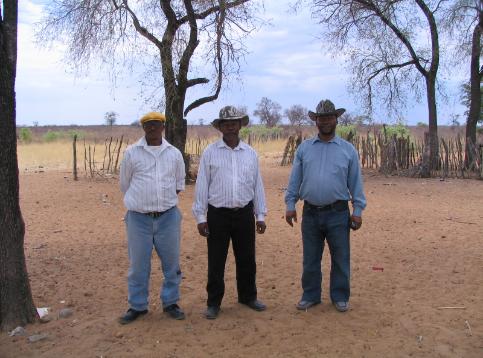
Three brothers: (from left) Attie Tsam, Adolph Tsam,Edward Tsam
On a visit to their old home in Tsintsabis, Oct. 2007
On a visit to their old home in Tsintsabis, Oct. 2007
Two of these songs are about eating meat. There are many ideas amongst the KhoeSan about
what sort of person can or should eat certain sorts of meat. Amongst Khoe speakers there is an
idea that certain things are soxa. Adolph explained this to mean that old people would term
something special, soxa, and if you did not do what they said in relation to it you would get into
trouble. Only certain men, for example, could eat the pangolin. If a child eats a pangolin and
consequently dies the body takes the form of a pangolin (curls forward, arms like a mantis).
Amongst most Bushmen groups the massive Eland antelope is considered a very special animal.
Edward described the Eland as a soxa animal because a snake lives in the hair in its forehead.
When the Eland is shot the snake falls out and runs. Many KhoeSan know of this snake.
Edward Tsam described how they just stopped singing songs when they left Tsintsabis to work on
the farm. He related it to the coming of the Church. When he was younger, before the church
people started visiting from Tsumeb, they didn't know about God. They were just talking about
Haiseb.
"Haiseb does wonderful things. When he is killed, he stands up "
" When good things happened people say it is the work of Haiseb. He makes the house, where
there is no house. He makes the rain, where there is no rain. If there are no clouds and then rain
is falling it is Haiseb"
what sort of person can or should eat certain sorts of meat. Amongst Khoe speakers there is an
idea that certain things are soxa. Adolph explained this to mean that old people would term
something special, soxa, and if you did not do what they said in relation to it you would get into
trouble. Only certain men, for example, could eat the pangolin. If a child eats a pangolin and
consequently dies the body takes the form of a pangolin (curls forward, arms like a mantis).
Amongst most Bushmen groups the massive Eland antelope is considered a very special animal.
Edward described the Eland as a soxa animal because a snake lives in the hair in its forehead.
When the Eland is shot the snake falls out and runs. Many KhoeSan know of this snake.
Edward Tsam described how they just stopped singing songs when they left Tsintsabis to work on
the farm. He related it to the coming of the Church. When he was younger, before the church
people started visiting from Tsumeb, they didn't know about God. They were just talking about
Haiseb.
"Haiseb does wonderful things. When he is killed, he stands up "
" When good things happened people say it is the work of Haiseb. He makes the house, where
there is no house. He makes the rain, where there is no rain. If there are no clouds and then rain
is falling it is Haiseb"
© 2009 Chris Hewson Low, All Rights Reserved
Academics and activism
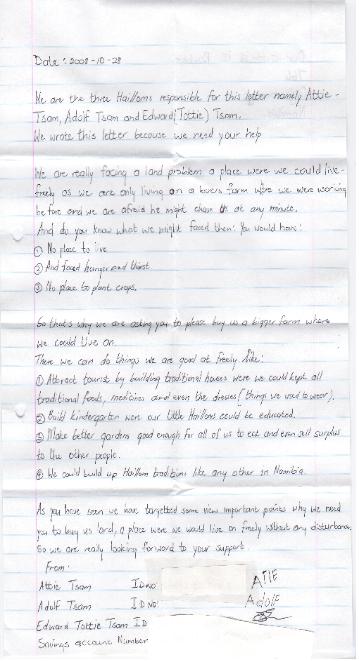
As I was leaving these brothers they implored me to
take this letter. I was very happy to but explained as
best I could, that it was unlikely I could help.
Unfortunately, like most of us, it is a speech I have
had to make many times. Attie had already described
to me how he followed the railway tracks at the same
time each week, in case a sack of something edible
had fallen off a scheduled goods train. Attie had
worked on the farm where I met these Bushmen for
16 years and prior to that for 20 years on a nearby
farm. He had not worked for five years. He had no
shoes. I bought him some shoes on our trip to
Tsintsabis. He will leave the farm with nothing.
I present the letter on this page as a reminder that
research is about people. At the same time, I told
these men that I would do what I can. After the
novelty of being a researcher in the field fades one
becomes increasingly aware of the inequality of the
situation. On occasions I have been sitting at home in
London and received phone calls from people in
Namibia. It then hits you. Two lives really collide.
Someone with no money bothered to call just to see
how you are. It is a jolt. Can you just hand out your
phone number ( or a false one as many end up
doing) and utter vague promises, ask people
sometimes extremely personal things, join in with their
lives…and just walk away?
As I was leaving these brothers they implored me to
take this letter. I was very happy to but explained as
best I could, that it was unlikely I could help.
Unfortunately, like most of us, it is a speech I have
had to make many times. Attie had already described
to me how he followed the railway tracks at the same
time each week, in case a sack of something edible
had fallen off a scheduled goods train. Attie had
worked on the farm where I met these Bushmen for
16 years and prior to that for 20 years on a nearby
farm. He had not worked for five years. He had no
shoes. I bought him some shoes on our trip to
Tsintsabis. He will leave the farm with nothing.
I present the letter on this page as a reminder that
research is about people. At the same time, I told
these men that I would do what I can. After the
novelty of being a researcher in the field fades one
becomes increasingly aware of the inequality of the
situation. On occasions I have been sitting at home in
London and received phone calls from people in
Namibia. It then hits you. Two lives really collide.
Someone with no money bothered to call just to see
how you are. It is a jolt. Can you just hand out your
phone number ( or a false one as many end up
doing) and utter vague promises, ask people
sometimes extremely personal things, join in with their
lives…and just walk away?
Link to an old Hai//om friend of the
brothers playing the //gwashi or quasi -
an instrument akin to a simplified kora;
essentially a soundbox with wooden
tuning rods and normally up to five
strings
Quasi playing, Tsintsabis 2007
Unfortunately the "cicadas" in the
background are the motor of the
camera..the second song is about
back ache
brothers playing the //gwashi or quasi -
an instrument akin to a simplified kora;
essentially a soundbox with wooden
tuning rods and normally up to five
strings
Quasi playing, Tsintsabis 2007
Unfortunately the "cicadas" in the
background are the motor of the
camera..the second song is about
back ache
Link to
!Kung Expedition IV, 1955 - footage
hosted by Smithsonian Institution
!Kung Expedition IV, 1955 - footage
hosted by Smithsonian Institution